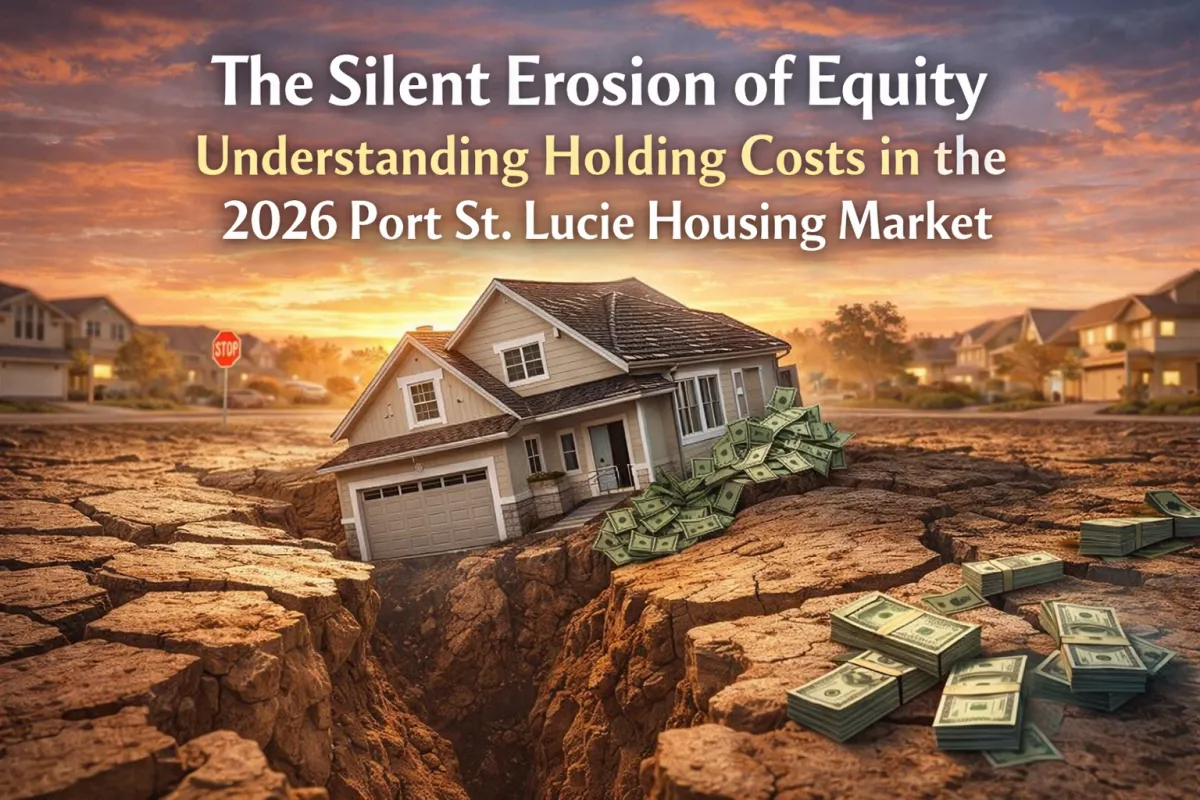
The Silent Erosion of Equity: Understanding Holding Costs in the 2026 Port St. Lucie Housing Market
The Silent Erosion of Equity: Understanding Holding Costs in the 2026 Port St. Lucie Housing Market
The Psychological Trap of the Highest Listing Price
For many homeowners in the Treasure Coast area, the process of selling a property begins with a single, intoxicating number: the estimated market value. In the stabilized real estate environment of 2026, where Port St. Lucie has seen a consistent leveling of appreciation, the focus for most sellers remains fixed on achieving the highest possible gross sale price. However, seasoned financial advisors and real estate economists argue that this fixation often obscures the most critical metric of a successful transaction: the net proceeds at the moment of closing.
The gap between a high offer and the actual cash a seller takes home is filled with a series of "silent" expenses known as holding costs. These are the recurring financial obligations that persist every single day a home remains on the market. In a climate where the average time to find a buyer in St. Lucie County now stretches toward the ninety-day mark, plus an additional thirty to forty-five days for mortgage underwriting, the "cost of waiting" can easily consume a significant portion of a homeowner’s equity. For those who prioritize financial efficiency, the decision to sell house fast port st lucie is often a calculated move to stop this financial hemorrhage before it undermines the total profit of the sale.
The 2026 Florida Insurance Crisis as a Holding Expense
Perhaps the most aggressive holding cost facing Port St. Lucie sellers today is the cost of property insurance. As we move through 2026, the Florida insurance market has undergone a significant restructuring, with premiums reflecting the increased frequency of climate-related events and the rising costs of construction materials. For a standard single-family home in neighborhoods like Torino or Gatlin Creek, monthly insurance premiums can now rival or even exceed the principal and interest portions of an older mortgage.
When a home is listed for sale, it often enters a state of vacancy or reduced occupancy, which can trigger "vacancy clauses" in standard insurance policies. These clauses often require additional riders or higher premiums to maintain coverage while the home is unoccupied during the showing period. If a property sits on the market for six months, the seller isn't just paying for the insurance they’ve always had; they are paying a premium for the privilege of waiting for a retail buyer. This reality has fundamentally changed the math for local residents, leading many to search for firms that say we buy houses port st lucie to avoid the escalating burden of these monthly premiums.
Property Tax Assessments and the Ad Valorem Burden
St. Lucie County has seen a steady rise in infrastructure development, from the expansion of the Crosstown Parkway to the burgeoning commercial hubs in Tradition. While these improvements enhance the long-term value of the area, they are funded through property tax assessments that do not pause when a home goes up for sale. In 2026, the daily tax liability for a mid-range home in Port St. Lucie is a non-negotiable expense that erodes the seller's bottom line with every sunset.
Because property taxes in Florida are paid in arrears, a seller who waits several months to find a buyer will see a larger "prorated tax" debit on their final closing statement. For a home with an annual tax bill of $6,000, every month spent searching for a retail buyer represents a $500 deduction from the final check. When combined with HOA fees, which have also seen inflationary increases across the Treasure Coast’s master-planned communities, the daily cost of "ownership without occupancy" becomes a formidable obstacle to true profit.
The Maintenance Cycle and the Risk of "Market Stale" Properties
Maintaining a home in the sub-tropical climate of Port St. Lucie is a full-time financial commitment. The 2026 buyer is notoriously discerning, often backed by professional home inspectors who utilize advanced moisture detection and thermal imaging. To keep a home in "show-ready" condition, a seller must continue to invest in lawn care, pool maintenance, pest control, and climate control to prevent the rapid onset of mold or mildew.
Furthermore, there is a psychological holding cost associated with a property’s "Days on Market" (DOM) count. In the digital age, buyers and their agents track how long a house has been listed with clinical precision. Once a property passes the sixty-day threshold without a contract, it often develops a reputation as being "stale" or "problematic." This perception frequently leads to low-ball offers or demands for aggressive repair concessions that far exceed the cost of the original repairs. By choosing to sell house fast port st lucie, homeowners can often bypass this downward spiral of perception and price, securing a fair value before the market begins to discount the property based on its age on the portal.
Opportunity Cost: What Your Equity Could Be Doing Instead
One of the most overlooked holding costs is the "opportunity cost" of tied-up capital. Most Port St. Lucie sellers are not just selling a house; they are attempting to unlock the wealth required for their next chapter—whether that is purchasing a smaller home in a 55+ community, investing in a new business venture, or funding a child’s education.
In the financial environment of 2026, where high-yield savings accounts and conservative investment portfolios are offering returns of 4 to 5 percent, $300,000 in home equity sitting stagnant in a listed house is actually "costing" the owner approximately $1,000 to $1,250 a month in lost interest income. When a seller waits six months to capture an extra $10,000 in gross sale price, they must subtract the thousands of dollars they could have earned had that money been in their bank account. Often, the math reveals that a quick, certain sale at a slightly lower gross price actually yields a higher "wealth-building" result over a twelve-month horizon.
The Modern Solution for Strategic Sellers
Recognizing these silent costs has led to a paradigm shift in how Treasure Coast residents approach real estate. The traditional model of listing with an agent and waiting for a financed buyer remains a viable path for those with pristine, modern homes and no time constraints. However, for a growing segment of the population, the direct sale model has become the preferred financial strategy.
Professional investment firms that state we buy houses port st lucie offer a "value of certainty." This value isn't just in the speed of the closing, but in the elimination of the holding cost variables. When a buyer offers cash and a ten-day closing, they are effectively handing the seller back three to six months of their life—and thousands of dollars in taxes, insurance, and maintenance fees. In the 2026 market, where efficiency is the new currency, being able to calculate an exact net profit on day one is an advantage that many homeowners find more valuable than a speculative "high" listing price.
Finalizing the Math of the Move
Before deciding on a selling strategy, Port St. Lucie homeowners are encouraged to create a "Holding Cost Ledger." This simple document should list the daily cost of the mortgage, insurance, taxes, utilities, and maintenance, alongside a conservative estimate of the opportunity cost of the equity. Seeing the "daily burn rate" of a property often clarifies the decision-making process.
If the daily cost to hold a home is $100—a common figure for many Florida properties in 2026—then a three-month delay in selling is a $9,000 expense. If a retail buyer then asks for $5,000 in repair credits following an inspection, the "high" offer has effectively cost the seller $14,000 in real-world dollars. By contrast, a direct sale that eliminates these months of waiting and the need for repairs often leaves the seller in a superior financial position, despite a lower initial headline price.
Further Reading on Market Efficiency
The evolution of the Port St. Lucie market continues to provide new ways for sellers to maximize their returns. Understanding the interplay between local infrastructure growth and residential property values is essential for any homeowner looking to time their exit perfectly. To explore more about the financial mechanics of modern Florida real estate and how to protect your equity from the silent costs of ownership, we invite you to read our featured article in the Port St. Lucie Real Estate Blog: The Financial Reality of the 2026 Market Reset. This resource offers a deep dive into the data-driven strategies that are helping local residents navigate the complexities of the current economy.
Conclusion: Priority of the Net
In the 2026 housing market, success is defined by what you keep, not what you ask for. By acknowledging the reality of holding costs—from the rising premiums of Florida insurance to the lost potential of stagnant equity—sellers can make empowered choices. Whether you choose the traditional path or decide to sell house fast port st lucie, the goal is to ensure that your home remains a financial asset rather than a monthly liability. The most successful sellers are those who look past the listing price and focus on the speed and certainty that preserve their hard-earned equity for the future.
