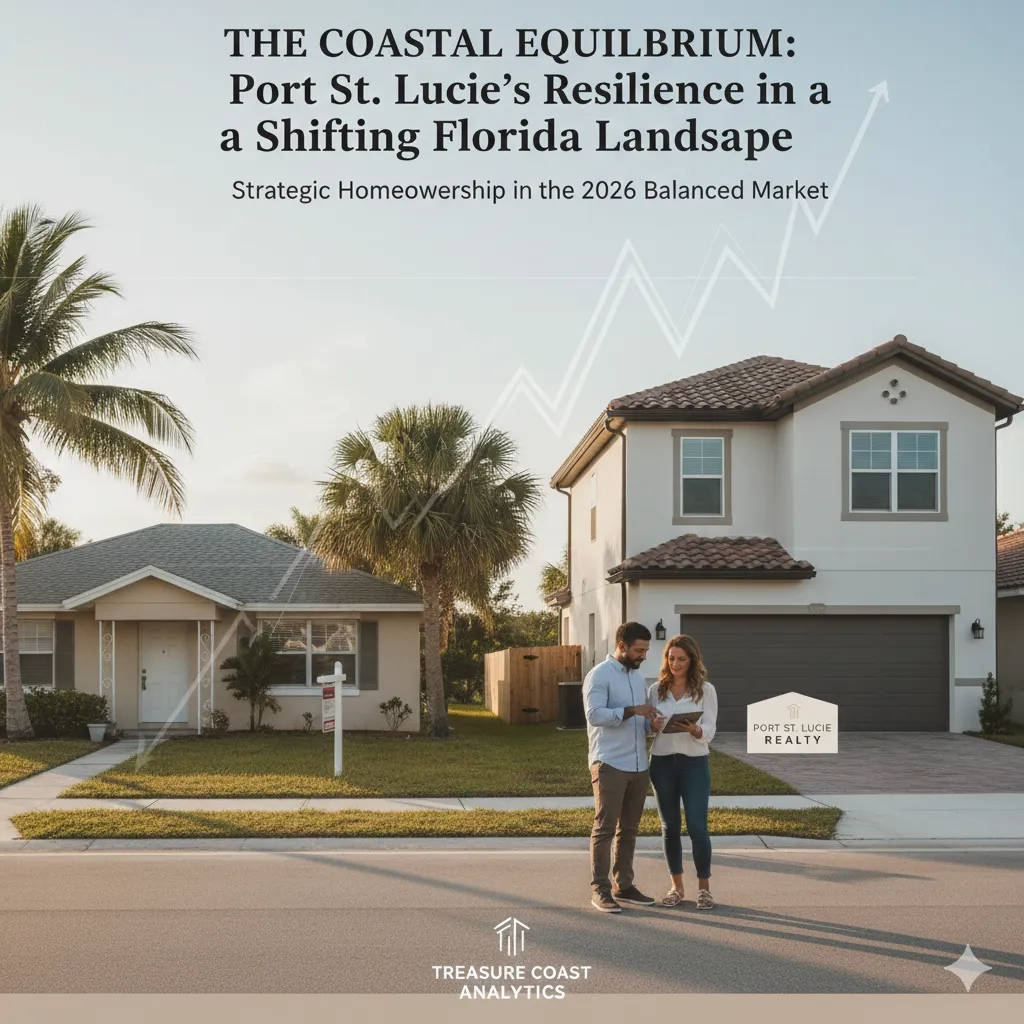
The 2026 Shift: Strategic Homeownership in Port St. Lucie’s Balanced Market
The 2026 Shift: Strategic Homeownership in Port St. Lucie’s Balanced Market
PORT ST. LUCIE, FL — As the calendar turns to 2026, the Port St. Lucie real estate landscape is demonstrating a remarkable level of maturity. For the better part of the last decade, this Treasure Coast gem was defined by a "boomtown" narrative—a period of rapid expansion that saw home values skyrocket and inventory levels plummet. However, the data from the early weeks of 2026 suggests we have entered a more measured, sophisticated era. The current environment is one of "coastal equilibrium," where the frenetic pace of the pandemic years has been replaced by a market that rewards strategic planning and efficiency over simple speculation.
For homeowners, this shift represents both a challenge and an opportunity. While the days of receiving ten sight-unseen offers within hours of listing have faded, the underlying fundamentals of the city remain exceptionally strong. Port St. Lucie continues to lead Florida in population growth and economic diversification, particularly within the healthcare and logistics sectors. Yet, as the "Days on Market" (DOM) metric stretches toward the 90-day average, residents are discovering that liquidity—the ability to convert a home into cash—now requires a more nuanced approach.
The Inventory Surge: Why "Waiting for the Right Buyer" Has Changed
One of the most defining characteristics of the 2026 market is the healthy surge in inventory. Recent reports indicate that the months of supply in St. Lucie County has risen to approximately 6.6 months. In real estate terms, this is the textbook definition of a "balanced market." While this is great news for the overall health of the city, it fundamentally changes the math for those who need to sell house fast Port St. Lucie.
When inventory was low, buyers were forced to compromise on condition, location, and price. In 2026, the roles have reversed. Today’s buyers are meticulous; they are taking their time to tour multiple properties, comparing everything from smart-home integration to the age of the roof. If a home isn't "retail-perfect," it risks becoming part of the "inventory overhang"—properties that sit active for months, eventually requiring deep price cuts to attract interest. This "holding period" is not just a test of patience; it is a direct financial drain in the form of taxes, insurance, and maintenance.
The Insurance Threshold: The New Non-Negotiable
Perhaps the greatest invisible hurdle in the 2026 sales cycle is the Florida insurance mandate. As homeowners' insurance premiums continue to be a primary concern for residents, the criteria for "insurability" have become remarkably strict. In Port St. Lucie, any home with a roof over 15 years old or an HVAC system nearing its second decade of service is essentially "un-mortgageable" in the traditional retail market.
In a standard transaction, a buyer’s lender will not fund a loan without proof of insurance. If the insurer refuses to write a policy due to the age of the roof, the deal collapses. This leaves the seller with a stark choice: invest $20,000 to $30,000 in a new roof before listing or find a buyer who doesn't rely on bank financing. For many, the ability to sell house fast Port St. Lucie to a cash buyer is the only viable path forward, as these buyers assume the repair risks and move to closing without the roadblocks of traditional insurance underwriting.
The Net Proceeds Analysis: Reevaluating the Retail Premium
A common pitfall for homeowners is focusing solely on the "gross sales price" found on sites like Zillow or Redfin. In a balanced market like 2026, the gap between the gross price and the net proceeds (the actual check you receive) is wider than ever. To understand the true value of an offer, a seller must subtract:
Real Estate Commissions: The standard 5% to 6% remains a significant equity drain.
Holding Costs: Three to four months of mortgage payments, property taxes, and HOA fees while waiting for a buyer.
Repair Concessions: The inevitable $5,000 to $10,000 credit requested by a buyer after a modern, detailed home inspection.
Closing Costs: Title insurance, documentary stamps, and recording fees.
When these costs are aggregated, many sellers find that a slightly lower cash offer—which carries zero commissions and closes in 14 days—actually results in a similar or even higher net profit than a retail sale that drags on for 100 days. Efficiency, in this market, has a quantifiable dollar value.
Economic Resilience: The "Tradition" Factor
Despite the cooling of the retail frenzy, the long-term value of Port St. Lucie real estate is supported by unprecedented infrastructure investment. The expansion of the Tradition Center for Commerce and the arrival of major logistics hubs like the Cheney Brothers distribution center have transformed the city into an employment powerhouse.
This economic base provides a "safety net" for property values. Unlike "vacation-only" markets that are highly sensitive to discretionary spending, Port St. Lucie is a city where people live, work, and raise families. For homeowners, this means that while the process of selling has become more complex, the value of the asset remains secure. The challenge isn't finding value; it's finding the most efficient way to unlock it when life necessitates a move.
The Demographics of Urgency: Relocation and Retirement
The 2026 market is also seeing a shift in who is selling. Port St. Lucie remains a top destination for retirees, but it has also become a hub for professional relocation. When a homeowner secures a new position in another state or a family needs to transition a loved one into assisted living, the luxury of a 90-day listing period is often non-existent.
In these high-stakes scenarios, the stress of "will it close?" is often more burdensome than the sale itself. This is why the direct-sale model has become so prevalent in the Treasure Coast. For those who need to sell house fast Port St. Lucie, the certainty of a non-contingent cash offer provides peace of mind that a traditional "subject to financing" offer simply cannot match. It allows the seller to plan their move with 100% confidence, knowing their equity is guaranteed and their timeline is protected.
The "As-Is" Advantage: Removing the Renovation Risk
In the current market, "curb appeal" has been elevated to an art form. Buyers are looking for the "Instagrammable" home—quartz countertops, vinyl plank flooring, and neutral paint. For a homeowner whose property is well-maintained but stylistically dated, the "retail gap" can be daunting.
To compete on the MLS, a seller might be advised to spend $40,000 on renovations. However, in a cooling market, there is no guarantee that they will see a 1:1 return on that investment. This is known as "renovation risk." By choosing an "as-is" sale, the homeowner skips the contractor headaches and the out-of-pocket costs. Professional buyers see the potential in the "bones" of the home, allowing the seller to walk away with their equity intact and their stress levels low.
Port St. Lucie’s Infrastructure: A Long-Term Bet
As we look toward the 2030s, the city’s proactive planning is evident. Projects like the Western Grove expansion and the continued development of the Crosstown Parkway have made Port St. Lucie one of the most accessible and well-planned cities in Florida. This foresight ensures that the city will remain a desirable destination for decades to come.
For a seller today, this means that their property is located in a "high-demand zone." Even if the retail market is slower than it was in 2021, the long-term demand for housing in this region is undeniable. The goal for a current homeowner is to navigate the present-day market hurdles—like insurance and high interest rates—to capture that value efficiently.
Strategic Liquidity: The Power of Choice
The most successful homeowners in 2026 are those who recognize that they have options. The traditional real estate model is a fantastic tool for those with "retail-ready" homes and no time constraints. However, for a significant portion of the population, the direct-sale path offers a more logical fit for their life goals.
The ability to sell house fast Port St. Lucie is not just about speed; it's about control. It’s about choosing your own move-out date, avoiding the "showing carousel," and knowing exactly how much money will be in your bank account at the end of the month. In a market that has returned to a state of balance, this level of certainty is the ultimate luxury.
Conclusion: Navigating the New Normal
Port St. Lucie has graduated from a "growth-at-all-costs" phase into a stable, mature metropolitan area. This transition has brought about a more disciplined real estate market—one that requires sellers to be more informed and more strategic than ever before.
Whether you are downsizing to a smaller home in St. Lucie West, relocating for a new career opportunity, or managing the affairs of a loved one's estate, the key is to weigh your options carefully. By understanding the true impact of inventory levels, insurance requirements, and holding costs, you can make a decision that protects your equity and your future. In 2026, the most valuable asset a homeowner has isn't just their property—it's their ability to choose the path to liquidity that best serves their needs.
